
Choosing a furniture hinge supplier is not just a price exercise. A hinge that looks solid in a catalog may sag after months of opening and closing. For buyers comparing a Furniture Hinge Company China, the useful questions are practical: What materials are used? How are load, cycle life, and corrosion resistance tested? Can the supplier provide samples that match the cabinet door and installation method? Small details matter. A cup that sits unevenly can leave a door visibly misaligned.
An illustrative expert voice, Chen Wei, a furniture-hardware sourcing specialist, puts the principle this way: “A dependable hinge is proven on the door, not just on the quotation.” This is an editorially composed line, not a verified published quotation. Use it as a reminder to check product evidence, factory quality controls, customization capacity, communication, delivery planning, and after-sales support. Ask for test records, inspect the finish under bright light, and compare sample movement across repeated cycles. Then confirm specifications in writing.
Seven tips can make the decision clearer. Still, no checklist catches everything. A supplier may answer quickly yet provide thin documentation; that deserves a second look. Consider how the company handles a failed sample, a revised drawing, or an urgent replacement request. Those moments reveal more than polished sales language. The best match is not always the largest factory or lowest quote. It is the partner whose claims can be checked and whose hinges work reliably in your actual furniture.
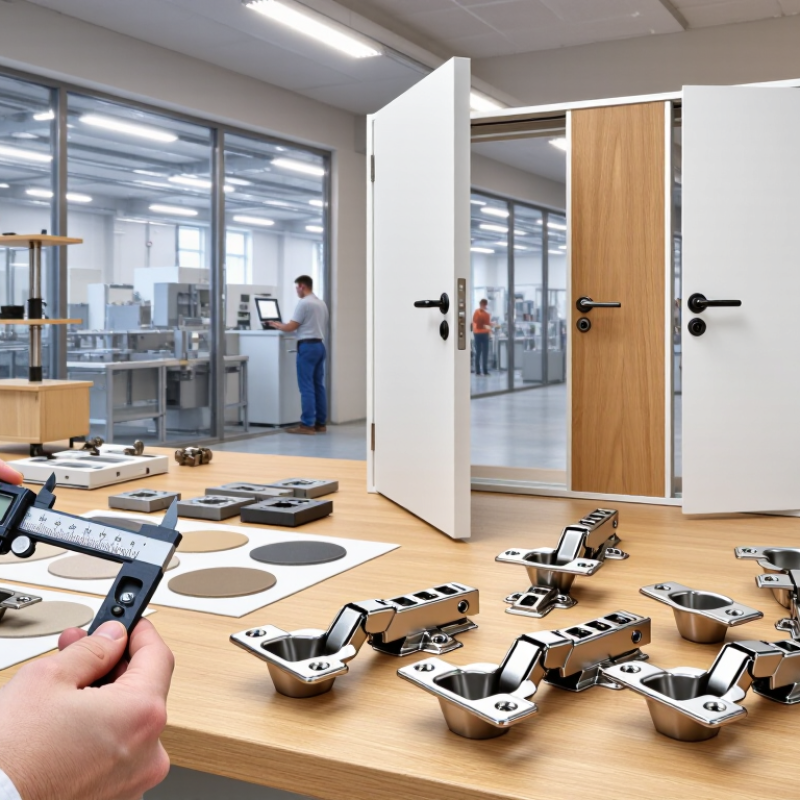
Before contacting a furniture hinge company in China, define the job the hinge must do. Note the cabinet or furniture type, door material, thickness, weight, and overlay. Measure carefully; a few millimeters can affect alignment. Specify the opening angle and whether you need soft-close or clip-on installation. Tip 1: Write down the measurements. A sketch with dimensions can prevent avoidable back-and-forth.
Think about daily use and surroundings. A bedroom wardrobe has different demands from a kitchen cabinet near steam and cooking oils. Describe expected opening frequency and any exposure to moisture. Ask what finish and material options suit those conditions, and request relevant test details rather than relying on broad durability claims. Tip 2: Check the mounting method. Confirm screw positions, cup diameter, and adjustment range against your panel design.
Share a clear specification sheet when requesting samples or quotations. Include the number of hinges per door, preferred finish, packaging needs, and expected order quantity. Ask how the supplier checks opening cycles, load performance, and dimensional consistency. Compare samples with your actual door and frame before approval. This step can feel slow. It is still cheaper than discovering a poor fit after production. Some requirements may change once you test a sample; record those changes and confirm the final version in writing.
Typical opening-angle ranges for concealed hinge designs (degrees)
Use the required door clearance and opening angle to narrow down hinge options. These ranges are indicative; confirm the exact specification, door thickness, overlay, and mounting requirements with the supplier.
Begin with the hinge you actually need: note its opening angle, overlay, material, load, and expected number of cycles. Then search Chinese manufacturers and trading companies separately; their roles and control over production can differ. Tip: Save each candidate’s website, factory address, product range, and contact details in one comparison sheet. A neat website is useful, but it does not verify a factory.
Compare technical evidence, not just catalog photos. Ask for dimensioned drawings, material specifications, finish options, and test reports that identify the tested hinge model. Check whether the report matches the product being quoted. Request clear answers about sample lead time, minimum order quantity, packaging, and defect handling. Shortlist only suppliers that respond with specific details. Quick replies are not proof of quality.
A small sample can reveal more than a long sales presentation. Fit it to a cabinet door and check alignment, smooth movement, screw seating, and any scraping after repeated opening. Keep notes and photos; memory gets fuzzy. It is easy to favor the lowest quote, but compare the same specification and order volume before deciding. If information is missing, mark it as unknown rather than filling the gap with assumptions.
When comparing a furniture hinge company, inspect the metal, not just the polished sample. Ask whether the hinge uses cold-rolled steel, stainless steel, or zinc alloy, and request material specifications for each model. Check the pin, knuckles, and mounting plate for burrs, uneven plating, or looseness. Small defects matter. A neat finish can hide inconsistent coating beneath it. Request coating-thickness records and salt-spray test results, noting the test method and hours tested. ISO 9227 describes salt-spray testing, but a passing result alone does not predict every kitchen or bathroom environment.
Manufacturing capacity should include measurable checks: cycle testing, load testing, and inspection records linked to production batches. Ask how the factory handles failed samples and whether the same hinge performs consistently across repeated runs. The 2024 Grand View Research report, Furniture Market Size, Share & Trends Analysis, estimated the global furniture market at USD 766.2 billion in 2023 and forecast 5.3% annual growth through 2030. This signals a large, evolving market, not proof of any supplier’s quality. Compare each company’s product range against your cabinet drawings: overlay, inset, soft-close, opening angle, and available mounting plates. More options can help. They can also complicate replacement orders, so confirm dimensions and compatible parts before approving a sample.
| Tip | Evaluation Dimension | What to Check | Useful Evidence or Questions |
|---|---|---|---|
| 1. Confirm material suitability | Materials and corrosion resistance | Identify the hinge material and finish for each model. Furniture hinges may use materials such as steel or stainless steel; suitability depends on the application, environment, and required appearance. | Request material specifications and finish details. For corrosion claims, ask for the applicable test method, test conditions, duration, and acceptance criteria. ISO 9227 specifies salt-spray test methods; it does not by itself set a universal pass level for every hinge. |
| 2. Assess manufacturing capability | Processes and production control | Check whether the supplier can consistently manage relevant operations such as stamping, forming, riveting, surface finishing, assembly, and packaging, either in-house or through controlled subcontracting. | Ask for a process flow, inspection checkpoints, equipment and tooling information, and details of how subcontracted processes are monitored. Confirm that the quoted production route matches the sample and order requirements. |
| 3. Compare product range and fit | Hinge types and cabinet compatibility | Look for options suited to the door and cabinet design, such as full-overlay, half-overlay, or inset configurations, along with compatible mounting plates and opening-angle options. | Request dimensioned drawings and installation instructions. Confirm door thickness, cup-hole dimensions, drilling pattern, overlay, mounting-plate height, and required clearances for the specific application. |
| 4. Verify performance claims | Load, cycle, and function testing | Evaluate performance using the complete hinge configuration and intended door conditions. Check opening and closing action, adjustment, soft-close behavior if applicable, and performance after repeated use. | Ask for test reports that identify the model, setup, door or test load, cycle count, test conditions, and results. Compare like-for-like test methods and criteria rather than relying on an unsupported cycle-life or load claim. |
| 5. Review quality assurance | Inspection and traceability | Determine how incoming materials, in-process dimensions, finished hinges, surface appearance, and packaging are checked. Confirm how defects, corrective actions, and batch identification are handled. | Request sample inspection records, a written inspection plan, defect-handling procedures, and an example of batch traceability. Ask whether inspection criteria can be agreed before production. |
| 6. Test samples before ordering | Sample validation and consistency | Install production-representative samples on the intended cabinet and door. Check fit, alignment, adjustment range, smooth movement, closing action, finish, and compatibility with other hardware. | Confirm whether samples use the same materials, tooling, finish, and assembly process planned for the order. Record approved drawings and sample details so later production can be compared against them. |
| 7. Check supply and after-sales readiness | Capacity, lead time, and support | Assess whether the supplier can support the required order quantity, repeat orders, packaging needs, and delivery schedule. Clarify how product changes and quality issues are communicated. | Request a production schedule, stated lead-time assumptions, packaging specifications, and a named contact for technical and quality matters. Agree in writing on change notification, replacement handling, and required order documentation. |
A furniture hinge may look simple, but small differences in steel thickness, plating, and pin fit can affect how a cabinet door performs. Ask a prospective supplier which quality standards guide its production, then request current test reports and inspection records. Check that the documents match the hinge type you plan to order. A certificate alone is not enough. Ask how the factory checks opening cycles, load capacity, and corrosion resistance, and whether those tests apply to finished products or just raw materials.
Customization should be practical, not just attractive on a sample board. Share a drawing with measurements, door weight, mounting details, and finish requirements. Ask for a pre-production sample, then install it on a real cabinet door. Listen for scraping. Check whether the gaps stay even. A sample can perform well while a large batch varies, so discuss acceptable tolerances and how inspections are recorded. I would not assume every requested change is easy; unusual dimensions can affect tooling, cost, and delivery time.
Reliability shows up in everyday communication. Ask who will confirm specifications, report production progress, and handle defects. Get lead times and packaging details in writing, including what happens if materials arrive late. Then compare the supplier’s answers with its actual sample and records. Good promises are common. Consistent details are harder to fake. A missed question or vague reply is worth noticing, even if the price looks right.
Tip: Compare like with like. Ask each supplier to quote the same hinge type, finish, opening angle, test requirements, packaging, and order quantity. Confirm whether tooling, samples, and replacement parts are included. A low unit price may hide costly exclusions. Not just price. Request a written breakdown, then compare the total landed cost. Also check how quickly the supplier answers technical questions and whether replies include drawings, measurements, and clear next steps. A polished quotation is useful; a vague answer about load capacity is not.
Tip: Test delivery promises against evidence. Ask for a production schedule with sample approval, inspection, packing, and dispatch dates. The World Bank’s 2023 Logistics Performance Index covers 139 economies and evaluates factors including shipment tracking, logistics competence, and timeliness. It is not a guarantee of one factory’s performance, but it shows why delivery checks should go beyond an estimated shipping date. Request recent shipment records and agree on how delays will be reported. A spreadsheet still cannot predict every disruption.
Tip: Put after-sales terms in writing before ordering. Clarify the warranty period, evidence required for a defect claim, response time, and whether replacement hinges or parts are available. Ask for installation guidance and a contact who can handle technical problems. Test a sample on an actual cabinet door, not only on a showroom board. Small details matter. One weakness in this comparison: sample performance may not match a full production batch, so define batch inspection and acceptance criteria too.