
A Pull Out Ironing Board Drawer saves space, but it should never be treated like an ordinary cabinet drawer. Its runners carry uneven weight, its folding frame needs clearance, and its hinges can catch fabric or fingers. Before pulling, remove nearby objects, open the drawer slowly, and support the board with one hand.
The Houzz 2024 U.S. Kitchen Trends Study reports that 76% of renovating homeowners upgraded their cabinets. That figure reflects a growing demand for practical storage, including concealed laundry and ironing solutions. The National Kitchen and Bath Association’s design research also highlights storage efficiency, ergonomic access, and multifunctional cabinetry as continuing priorities. These reports support a simple principle: convenience must work with safe movement.
Cabinetmaking educator Gary Katz repeatedly promotes the workshop rule, “Measure twice, cut once.” It applies here, even when you are only operating a finished drawer. Check whether the runners are fully extended. Look for a release lever, locking stop, or soft-close resistance. Never force the drawer past its designed travel. A slight wobble may indicate loose hardware, uneven loading, or a damaged runner.
This guide explains how to Pull Out Ironing Board Drawer safely in 2026, using clear checks and practical details. You may find that your cabinet uses a proprietary mechanism. That is the imperfect part. Without the manufacturer’s instructions, certainty is limited. Still, careful observation usually reveals the release points, clearance limits, and correct folding sequence. A phone flashlight helps. So does patience.
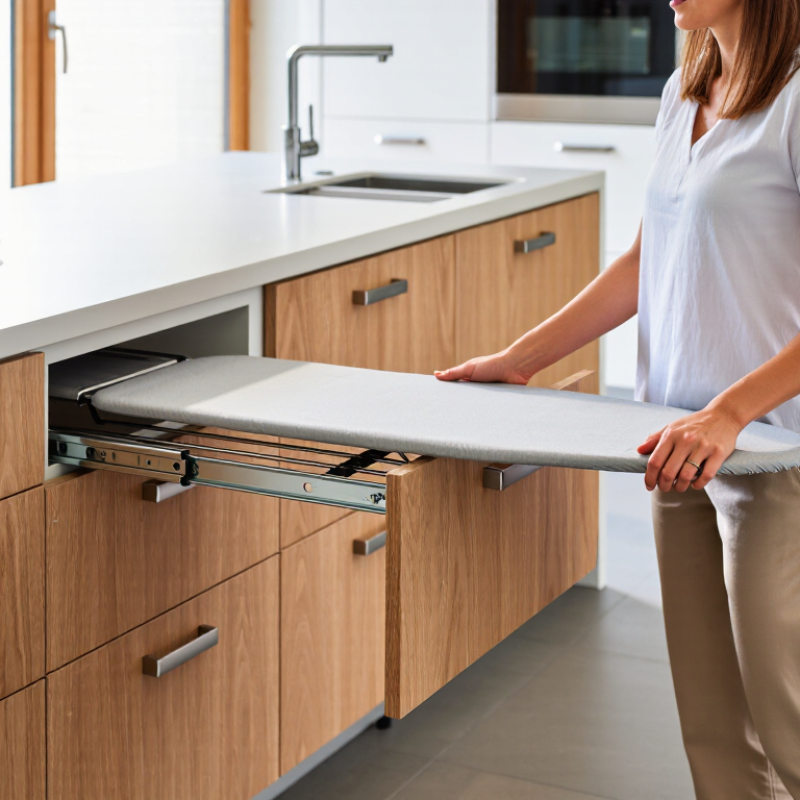
How to Pull Out an Ironing Board Drawer in 2026?
Identify the drawer style before pulling. Some ironing boards use a shallow front drawer. Others hide behind a cabinet panel or slide from the side. A full-extension drawer usually has visible metal runners. A concealed model may move only after its front panel is pressed. Do not yank the handle. The board may be attached to folding hinges, and sudden movement can pinch your fingers.
Check for safety locks around the drawer edges and underneath the front panel. Look for a small release tab, locking lever, or child-safety catch. Remove clothing and nearby objects before testing the mechanism. Hold the drawer with both hands, then pull slowly until you feel resistance. If the lock clicks, press the release gently while maintaining light pressure. Never force a stuck drawer with a knife or heavy tool. From practical repair work, most damage comes from pulling before locating the latch. I have made that mistake myself.
Tips: Use a flashlight inside the cabinet. Keep fingers beside the handle, not below the board. If the runners look bent, stop and photograph their position. Check the user instructions when available. A drawer that feels unusually heavy may contain a loose hinge or uneven load. Do not continue until the cause is clear.
How to Pull Out an Ironing Board Drawer in 2026?
Clear the cabinet area before pulling out the ironing board. Remove folded clothes, baskets, spray bottles, and loose hangers from nearby shelves. A small object can block the drawer or fall behind it. Check the floor, too. Shoes and storage boxes can restrict the drawer’s movement.
Open the cabinet door fully, then place one hand on the drawer handle. Pull slowly and evenly. Do not twist the drawer from one side. Most ironing board drawers use runners that need a straight motion. Watch for screws, rough edges, or a raised runner inside the cabinet. If the drawer stops, push it back slightly and inspect the track with a flashlight. Forcing it may bend the hardware or damage the cabinet frame.
I once overlooked a cloth bag near the lower runner. It seemed harmless, but the drawer caught against it. That mistake reminded me to clear more space than seems necessary. Keep children and pets away while checking the mechanism. If the drawer feels unusually heavy, support its underside before extending it further. Some older cabinets have worn runners, and their condition is not always obvious. Stop if you notice splitting wood, loose fasteners, or a sharp metal edge. A careful pause is better than a quick repair.
| Step | Action | What to Check | Reason | Status |
|---|---|---|---|---|
| 1 | Turn on the room lighting and inspect the cabinet front. | Confirm the drawer handle, front panel, and surrounding trim are visible. | Good visibility helps prevent pulling the wrong panel or catching nearby fittings. | Ready |
| 2 | Clear the cabinet area before pulling out the ironing board. | Remove baskets, bottles, clothing, cords, and other objects from the drawer path and floor area. | Obstructions can stop the drawer, cause items to fall, or create a tripping hazard. | Required |
| 3 | Check the floor immediately in front of the cabinet. | Leave a clear standing area wide enough for both feet and free of loose rugs or wet spots. | A stable stance gives better control while the drawer is moving. | Clear |
| 4 | Inspect the drawer track and front edge. | Look for visible screws, bent metal, loose parts, or objects caught beside the runners. | A damaged or obstructed track may require repair rather than additional force. | Inspect |
| 5 | Stand directly in front of the drawer and hold the handle with both hands if available. | Keep fingers away from the sides, hinge points, and gaps between moving parts. | This reduces the risk of pinched fingers and uneven loading. | Safe grip |
| 6 | Pull the drawer slowly and evenly until the ironing board is fully accessible. | Stop if the drawer binds, tilts, scrapes, or requires unusual force. | Smooth movement indicates that the drawer path is clear and the runners are aligned. | Pull gently |
| 7 | Unfold or rotate the ironing board according to its built-in mechanism. | Support the board while releasing any latch or folding joint. | Supporting the board prevents sudden movement and reduces stress on the hardware. | Support |
| 8 | Close and store the board only after it has cooled and the area is clear. | Ensure the board is folded correctly and no fabric, cord, or accessory is trapped in the drawer. | Correct storage helps prevent heat damage, snagging, and future drawer obstruction. | Finish |
Pull the drawer open slowly until you feel resistance. Do not yank it. Most ironing board drawers use small stops, side latches, or metal support arms to prevent complete removal. Empty the board first, then place one hand beneath its front edge. A flashlight can reveal the release points under the drawer sides.
Look for plastic tabs, screw-mounted stops, or paired levers on both runners. Press the tabs inward while gently pulling the drawer forward. Some latches release by lifting one side slightly, but forcing the angle can bend the runner. For metal stops, loosen the retaining screws only if the drawer does not slide past them naturally. Keep the screws in a small container.
Support mechanisms need extra care. Hold the ironing board with one hand while releasing each support arm. Spring-loaded parts may snap back. Move your fingers away from the hinge line. If the board feels heavy, ask someone to steady it. I once missed a hidden stop beneath the left runner and pulled too hard. The drawer came free, but the runner twisted slightly. That mistake taught me to inspect both sides before applying pressure.
After releasing the mechanisms, pull the drawer straight toward you. Keep the runners level. If movement remains rough, stop and check for a trapped cord, loose screw, or bent bracket. A clean cloth can remove dust, but avoid adding lubricant until the mechanism’s instructions permit it.
How to Pull Out an Ironing Board Drawer in 2026?
Pulling out an ironing board drawer safely requires even pressure, not force. Clear nearby clothing, cords, and storage items before touching the handle. Stand directly in front of the drawer. Place both hands near the center or use the handle with both hands. Pull slowly and evenly toward your body. Keep the drawer level. A tilted drawer can bind against its runners or cabinet frame.
If the drawer feels stiff, stop pulling harder. Push it inward by a few centimeters, then try again with balanced pressure. Check for fabric, loose objects, or a twisted board inside. Some drawers use soft-close runners, while others have catches or release levers. Inspect the sides carefully before removing anything. I once pulled from one corner, and the drawer shifted awkwardly. That small mistake made the movement rougher and noisier.
Tips: Keep your feet steady and avoid sudden jerks. Support the ironing board as it extends, especially when it is heavy. If one side moves first, close the drawer and realign your hands. A small amount of resistance is normal, but scraping, cracking, or uneven movement needs attention. Do not force hidden stops. Check the installation instructions or ask a qualified repair professional when the mechanism remains stuck.
Pull the ironing board drawer out using even pressure from both sides to keep the runners aligned and reduce twisting.
The chart shows the drawer’s opening progress from fully closed to fully extended. At every stage, keep the left and right sides moving together and apply steady, even pressure rather than pulling from one side.
Pull the ironing board drawer fully open, then support its front with both hands. Many drawers use release levers, while others lift from the runners. Check underneath before applying force. I have seen homeowners bend a runner by pulling at an angle. Do not force it. Press or lift both release points evenly, then slide the drawer forward. Keep loose screws in a small container.
Inspect each runner for bent metal, missing screws, dirt, or uneven spacing. A damaged runner can make the drawer drop suddenly. The U.S. Consumer Product Safety Commission’s 2023 Furniture Tip-Over Report estimated 71,300 emergency-department injuries from furniture tip-overs between 2018 and 2022. This drawer may be smaller, but stable hardware still matters. Clean the tracks with a dry cloth. Avoid heavy oil, which can collect dust and affect smooth movement. Measure the gap on both sides. It should look nearly equal.
To reinstall the drawer, align both runners at the same angle. Push slowly until the locking points engage. Pull the drawer out halfway and test for wobbling. Then close it gently several times. The drawer should move quietly and remain level. If one side catches, remove it and realign the runners rather than tightening random screws. I sometimes expect a quick repair, yet small alignment errors can remain hidden. Check the board’s support legs before regular use, and never exceed the hardware maker’s stated load limit.